Why AI for Business Matters Today
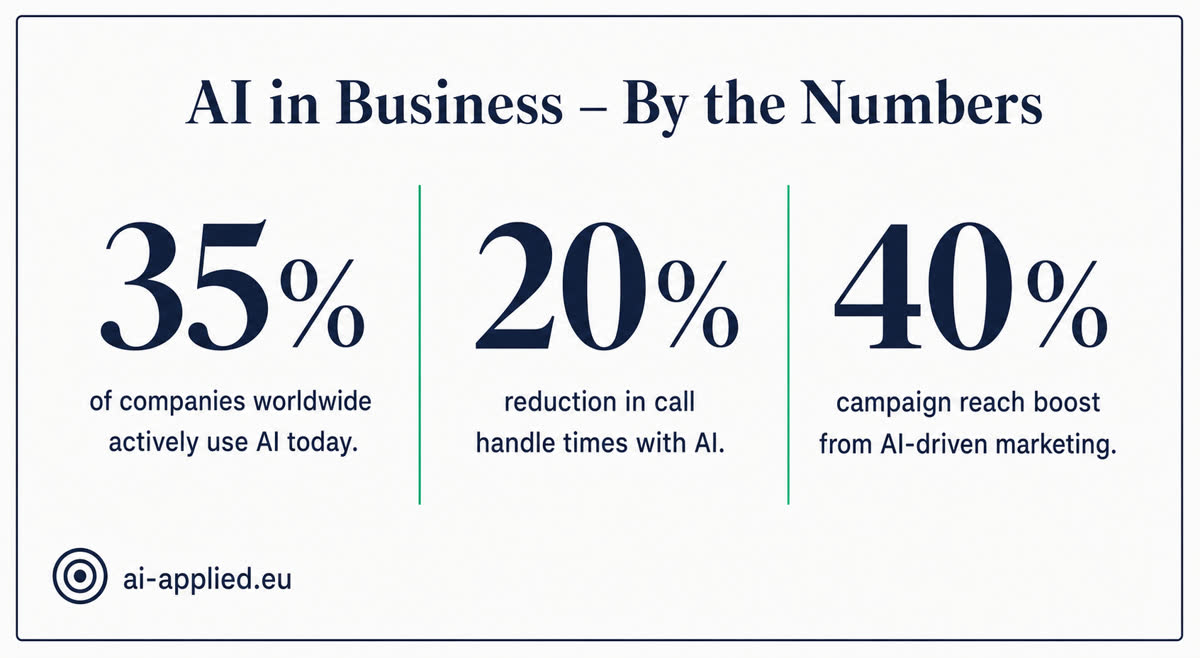
AI delivers measurable impact across three core dimensions: cost reduction, revenue growth, and productivity gains.
Companies using AI report a 20% reduction in call handle times and 15% productivity boosts in contact centres. In 2026, AI-related investment is expected to contribute roughly 25% of U.S. GDP growth.
Global data centre construction costs are projected at $2.9 trillion through 2028 – industrial-scale build-out driven by real demand, not speculation.
Beyond raw statistics, AI reshapes decision-making. By synthesising vast datasets, surfacing insights, and automating reporting, AI helps teams make better decisions faster.
The shift from manual analysis to data-driven automation lets businesses respond to market changes in real time, from dynamic pricing in retail to predictive maintenance in manufacturing.
Key Areas Where AI Is Used in Business
Operational Efficiency
The most immediate ROI from AI comes from automating manual, repetitive, and error-prone processes across operations, support, and back-office functions.
Process automation lowers labour costs, increases throughput, and frees employees to focus on higher-value work.
Toyota implemented an AI platform on Google Cloud that lets factory workers develop and deploy machine learning models themselves, accelerating production cycles without expanding headcount.
In logistics, Recurso Confiable in Latin America now tracks seven times more shipments than before, reduced rejections by 3%, and delivers real-time shipment updates in under two seconds. Worker access to AI rose by 50% in 2025.
Customer Experience and Support
AI-powered customer service is the most common use case for artificial intelligence in business, deployed by 56% of companies.
Chatbots, virtual assistants, and AI-enabled contact centres provide 24/7 support, faster resolution times, and more relevant interactions.
Discover Financial created a virtual assistant powered by generative AI that assists customers directly and gives real-time recommendations to service agents.
Definity cut call handle times by 20% and boosted productivity by 15% by using AI to summarise calls, automate caller authentication, and analyse customer sentiment.
Marketing and Sales
AI solutions for business are changing how companies personalise content, optimise campaigns, and score leads.
Generative AI automates market research, contract analysis, and client reporting. Tasks that once took days now complete in minutes.
Incrementa, a Chilean marketing company, uses Gemini Enterprise to automate client reporting and data analysis, scaling personalised service and boosting campaign reach by 40%.
Retail companies use AI to adjust prices in real time based on demand, competition, and customer behaviour. AI-driven demand forecasting reduces inventory holding costs, while personalisation engines increase conversion rates and average order values.
Human Resources and Talent Management
AI is reshaping recruitment, onboarding, and workforce planning. Automated hiring tools screen candidates faster and more accurately.
Upwork uses Vertex AI to deliver faster, more accurate talent matching for businesses and freelancers. HR teams use AI to analyse employee sentiment, predict turnover risk, and recommend training programmes.
By automating tedious, repetitive HR tasks, AI frees teams to focus on strategic initiatives like culture-building and leadership development.
Finance, Risk, and Fraud Detection
In finance and healthcare, AI performs compliance checks, highlights gaps before audits, and detects fraud in real time.
Cybersecurity and fraud management represent the second-most common AI use case, deployed by 51% of companies.
Financial services firms use generative AI to generate reports, review contracts, and monitor transactions for anomalies in real time.
What Makes Generative AI in Business Different?
Generative AI in business goes beyond analysing data or automating workflows. It creates new content, code, reports, emails, and designs on demand.
Unlike traditional AI models trained to classify or predict, generative AI produces original outputs based on prompts. That makes it uniquely valuable for creative, communication, and knowledge-work tasks.
CarMax uses generative AI to summarise customer reviews and post summaries on research pages for shoppers.
Valeo deployed Gemini for Workspace to its entire 100,000-person global workforce. More than 35% of Valeo’s code is now AI-generated.
Huge, an American business services agency, created AI agents that automate market research and contract analysis, generating new business intake in minutes instead of days.
Generative AI performs well in roles that require speed, scale, and consistency: content creation, customer communications, software development, and scenario modelling.
Introducing Agentic AI: The Next Evolution
Agentic AI in business represents a step beyond chatbots and basic generative models. Rather than simply responding to prompts, agentic AI systems plan, execute, and adapt across multiple tools and workflows without constant human oversight.
These AI agents can orchestrate end-to-end processes: pulling data from CRMs, updating ERPs, scheduling follow-ups, and escalating exceptions.
More than half of companies (58%) report at least limited use of physical AI today. That figure is expected to reach 80% within two years, with Asia Pacific leading early adoption.
Unlike traditional chatbots that operate in isolation, agentic AI integrates with enterprise platforms, learns from interactions, and improves over time.
This makes it well suited for customer relationship management (46% adoption), inventory management (40%), and digital personal assistants (47%).
The Future of AI in Business
The future of AI in business points toward hyper-automation, AI-native workflows, and entirely new business models.
As AI agents embed deeper into CRMs, ERPs, and internal platforms, companies will shift from deploying isolated AI tools to orchestrating interconnected AI ecosystems.
Forty-two percent of organisations say optimising AI workflows and production cycles is their top spending priority in 2026. Physical AI adoption has risen by 22 percentage points in two years.
Emerging trends include AI-driven scenario modelling for supply chains, real-time ESG risk detection, and AI platforms that let non-technical employees build and deploy models.
How to Implement AI in Business: A Practical Roadmap
Successfully implementing AI requires more than purchasing software. It demands a deliberate, phased approach aligned with business goals.
- Assess current pain points and map candidate use cases. Identify repetitive, high-volume, or error-prone processes where AI can deliver immediate value. Focus on areas with clear ROI: cost savings, time reduction, or quality improvement.
- Start small with a focused pilot. Choose one department or workflow, deploy AI in a controlled environment, and measure results rigorously: handle time, throughput, accuracy, and employee satisfaction.
- Choose platforms aligned with your stack. Integrate AI with existing SaaS platforms, APIs, and data infrastructure. Make sure solutions can scale across teams and geographies without requiring a complete IT overhaul.
- Train teams, redefine roles, and measure impact. AI success depends on human adaptability and trust. Provide training, communicate transparently about job changes, and involve employees in designing AI-augmented workflows.
- Scale by connecting AI agents into end-to-end workflows. Once pilots prove successful, expand AI across functions and into strategic planning. Move from isolated tools to integrated agentic systems that orchestrate multi-step processes.
Top priorities for scaling include scalability across data sources (92%), data and metric portability (83%), and AI governance and observability (82%).
Less than half (44%) of organisations report adequate data quality and accessibility for AI, making data infrastructure a critical bottleneck.
Common Pitfalls and Governance
Even well-intentioned AI initiatives fail when companies automate broken processes without redesigning them first. Over-automation without process improvement simply scales inefficiency faster.
Before deploying AI, map workflows end-to-end, eliminate redundancies, and clarify decision rights.
Data quality, security, and ethics remain persistent challenges. Eighty-seven percent of leaders demand greater visibility into how AI uses and interprets their data.
Establishing AI governance frameworks, covering data access, model transparency, bias monitoring, and compliance, is essential for sustainable scale.
Human oversight remains critical even with agentic AI. Define clear escalation paths, maintain human-in-the-loop checkpoints for high-stakes decisions, and build a culture where employees feel confident questioning AI outputs.
Conclusion
Artificial intelligence in business is no longer a distant innovation. It is a present-day competitive advantage reshaping industries from retail and finance to manufacturing and healthcare.
Whether you are deploying generative AI for content creation, agentic AI for autonomous workflows, or predictive models for risk management, the opportunity to drive measurable ROI is real and accessible.
Start by auditing one workflow in your organisation. Sketch an AI-enabled version. Identify bottlenecks, estimate time savings, and pilot a solution with clear success metrics.
The companies winning with AI today are not waiting for perfect conditions. They are learning by doing, scaling what works, and building AI-native capabilities one process at a time.
Ready to get started? Book a complimentary AI-readiness audit to identify your highest-impact use cases.
FAQ about AI in business
What is artificial intelligence in business?
Artificial intelligence in business refers to using AI tools, models, and systems to automate tasks, improve decisions, and drive efficiency across operations, customer service, marketing, finance, and HR. It covers everything from simple rule-based automation to advanced agentic AI that plans and acts across multiple systems.
How is AI used in business today?
AI is used across every major business function. The most common applications include customer support automation (56% of companies), fraud detection (51%), personalised marketing, demand forecasting, HR screening, and financial reporting. Many businesses are also starting to deploy agentic AI that handles multi-step workflows end-to-end.
What is the difference between generative AI and agentic AI in business?
Generative AI creates content, code, and reports based on prompts. Agentic AI goes further: it plans, executes multi-step tasks, and adapts when conditions change, often without human input at each step. For business, generative AI handles creation while agentic AI handles orchestration and workflow automation.
How do I start implementing AI in my business?
Start by identifying one high-volume, repetitive process with a clear ROI case: customer support, order processing, or lead research are good entry points. Run a time-limited pilot, measure results against a baseline, then expand. You do not need a large technical team to start, as many no-code and low-code platforms make AI deployment accessible to non-technical teams.
What are the biggest risks of using AI in business?
The main risks are automating broken processes (which scales the problem), poor data quality undermining AI outputs, and insufficient human oversight for high-stakes decisions. Security and compliance are also concerns, particularly when AI agents connect to live business systems. Building clear governance frameworks before scaling is the most reliable way to manage these risks.
