What Are AI Agents and Why Does Everyone Suddenly Care?
You keep hearing the phrase “AI agents.” But nobody seems to explain what they actually do, or why it matters for you.
This guide explains what AI agents are in plain English, how they work, and where they actually add value in a real business.
Regular AI tools answer questions. AI agents go further: they take action, make decisions, and keep going until a job is done. That shift is bigger than most people realise.
Whether you run a business, work in a professional role, or just want to understand where AI is heading, this guide gives you a clear, honest picture of what AI agents are and what they are not.
What Are AI Agents, Exactly?
An AI agent is software that can perceive its environment, set goals, plan steps, and carry out actions on its own.
Think of it less like a calculator and more like a junior colleague who works independently. You give it an objective, and it figures out how to get there.
That is the core difference from a standard chatbot. A chatbot waits for a question and gives an answer. An agent takes initiative.
How Do AI Agents Actually Work?
Every AI agent runs on a loop of four key steps:
- Perceive – It reads inputs: emails, data, instructions, system states.
- Plan – It decides what to do next to reach the goal.
- Act – It carries out actions: send a message, run a search, write code.
- Adapt – It checks the result and adjusts its next step accordingly.
This loop keeps running until the task is complete, or until the agent flags it needs human input.
That ability to adapt mid-task is what separates these systems from simple automation. A rule-based bot follows a fixed script. An agent works around obstacles.
How Are Businesses Using AI Agents Right Now?
This is not theoretical. The technology is already running inside real organisations. Here are some concrete AI agent examples you can relate to.
Customer Support
Agents handle entire support conversations, not just the first reply. They check account history, process requests, and escalate only when a situation genuinely needs a human.
Sales Prospecting
They research leads, draft outreach messages, follow up at the right time, and log activity into a CRM. A salesperson can focus on conversations, not admin.
Finance and Fraud Detection
Macquarie Bank deployed agents to review fraud alerts. The result was a 40% reduction in false positive fraud alerts, freeing analysts for cases that needed real judgement.
Order Processing
Danfoss, a global engineering company, automated 80% of email order decisions this way. Response time dropped from 42 hours to near real-time.
Coding and IT
Agents write code, run tests, flag bugs, and push fixes. IT teams use them to monitor systems and resolve routine incidents without manual intervention.
What About Multi-Agent Systems?
Sometimes one agent is not enough. Multi-agent systems put several to work together, each handling a different part of a larger task.
Think of it like a small team: one agent researches, one drafts, one reviews, one publishes.
When agents collaborate, they can handle workflows that would previously require a whole department. They pass information between each other, check each other’s work, and flag conflicts.
Frameworks like LangChain, CrewAI, AutoGen, and LangGraph are among the most common tools used to build these systems.
For businesses, multi-agent setups mean that complex, multi-day tasks can run end-to-end with far less manual coordination.
AI Agents and Moltbook
If you have seen the phrase “AI agents moltbook” and wondered what it means: Moltbook is a kind of social network built for AI agents rather than humans. Agents create profiles, post, reply, and interact with each other while humans mostly watch from the outside.
For now, platforms like this are experimental. They do show what happens when thousands of agents can talk to each other, share information, and act on what they read.
It is an early preview of how agentic AI might behave at scale, both in good ways and in ways security teams need to take seriously.
What Does Agentic AI Mean for Your Business?
Agentic AI does not replace your team. It changes what your team spends time on.
When repetitive, multi-step tasks run on their own, people can focus on work that actually needs human thinking: strategy, relationships, creative decisions.
Telus, a Canadian telecoms company, rolled out AI across 57,000 staff and reported saving an average of 40 minutes per AI interaction. Across an organisation of that scale, those minutes add up fast.
Gartner predicts 40% of enterprise applications will include task-specific AI agents by the end of 2026, up from fewer than 5% in 2025. The window to get ahead of this shift is open right now.
How to Start Building AI Agents
If you are wondering how to create agentic AI for your business, you usually have two options.
You can start from ready-made platforms that let you configure agents with no-code or low-code tools. Or you can work with a technical team to build custom agents on top of frameworks like LangChain, CrewAI, AutoGen, or LangGraph.
The first option is faster to launch. The second gives you more control over data, integrations, and risk boundaries.
Who Is Already Using AI Agents?
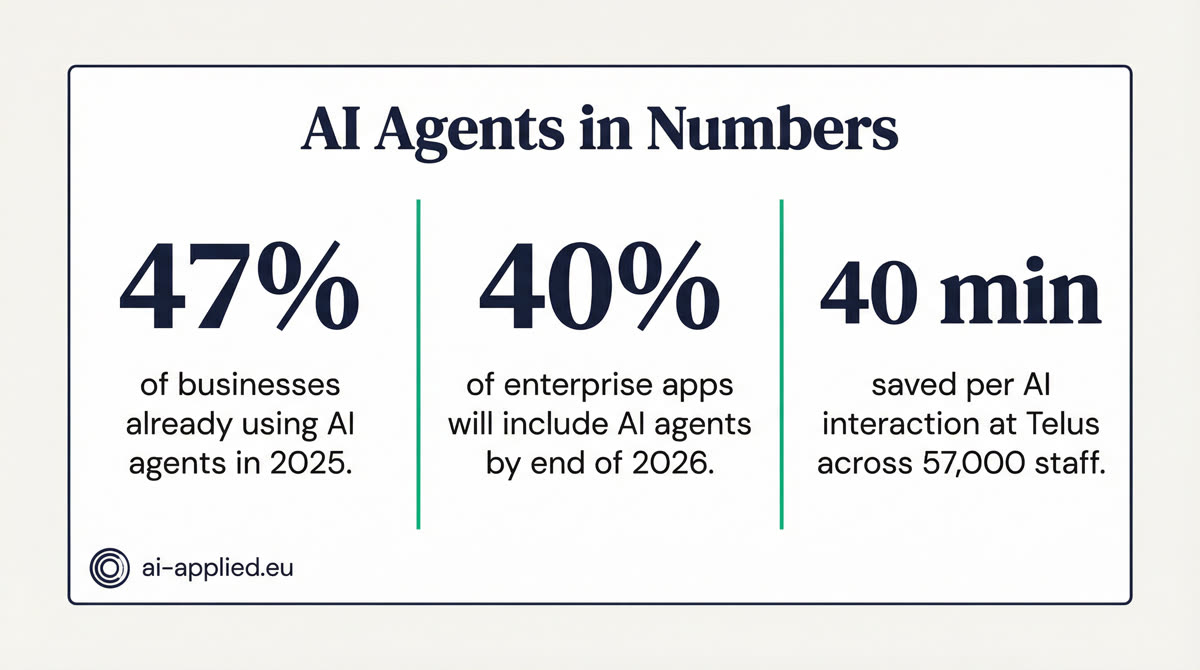
More people than you might expect. A 2025 report by Glide found that 47% of businesses are already using AI agents in some form.
Agentic AI is no longer a pilot project for big tech firms; it is something mid-sized businesses are running today.
Early adopters are seeing gains in speed, consistency, and capacity. Teams bottlenecked by volume are getting real breathing room.
What Are the Real Risks?
Any honest conversation about AI agents has to include the risks. They can and do make mistakes, and when acting autonomously, those mistakes can move fast.
A poorly configured agent might send the wrong email or make a bad call in a financial process.
The risks worth watching include:
- Errors compounding – Agents act on their own outputs, so one bad step can cascade.
- Lack of context – They do not always know what they do not know.
- Security exposure – Agents connected to live systems are a potential attack surface.
- Accountability gaps – When an agent makes a decision, who is responsible?
Human oversight is not optional. The smartest implementations build in review points, approval gates, and clear boundaries.
Agentic AI works best when humans stay in the loop for anything consequential.
Conclusion
AI agents are running in businesses right now, handling real tasks, and producing real results.
Understanding what they are, and what they are not, is the first step to using them well.
The organisations getting the most from this shift are not replacing their teams; they are giving them better tools to work with.
FAQ about AI agents
What is the difference between an AI agent and a chatbot?
The key difference is autonomy. A chatbot responds to one question at a time. An AI agent takes on a multi-step goal, plans a route, carries out actions, and adjusts when things change.
Are AI agents safe to use in a business?
They are safe when implemented carefully. The main risk is giving them too much autonomy without review points. Best practice is to define clear boundaries, log all agent actions, and keep humans in control of any consequential decision.
Do I need a technical team to use AI agents?
Not always. Many platforms now offer no-code or low-code options aimed at business users. More complex implementations, especially those connecting to core business systems, still benefit from technical oversight.
What kinds of tasks are AI agents best suited for?
They perform well on repetitive, multi-step, rule-adjacent work: processing orders, triaging support tickets, researching leads. They are less suited for tasks needing deep human judgement or emotional intelligence.
How is agentic AI different from regular automation?
Traditional automation follows a fixed script. If something unexpected happens, it stops or fails. Agentic AI can read a situation, adjust its plan, and keep going, which is what makes it useful for real-world tasks.
