Most businesses have tried AI. A chatbot here, an autocomplete there. But agentic AI in business is a different animal entirely. It doesn’t wait to be told what to do: it plans, decides, and acts on its own to hit a goal. That shift from reactive to autonomous is what makes this technology worth understanding. This article breaks down what agentic AI actually is, how companies are using it right now, and what you need to know before you start.
What Is Agentic AI, Exactly?
Agentic AI is an AI system that can act independently to achieve a predefined goal. Unlike a standard chatbot that answers one question at a time, an agentic system plans a sequence of steps, makes decisions, and executes tasks across multiple tools, often without any human in the loop.
The simplest way to think about it: you give it a goal, not a command.
According to AWS, agentic AI systems are built with modular components, reasoning engines, memory, and connected tools, that let them handle sophisticated workflows with accuracy.
They also adapt. If conditions change mid-task, the agent adjusts. That’s what separates it from older-style automation.
How Is Agentic AI Different from Generative AI?
Generative AI creates content – text, images, code. Agentic AI acts. It perceives its environment, reasons through a problem, takes action, and learns from the result.
A generative AI writes the email. An agentic AI writes it, finds the right contact, sends it, and logs the outcome.
Why Is Agentic AI in Businesses Moving Now?
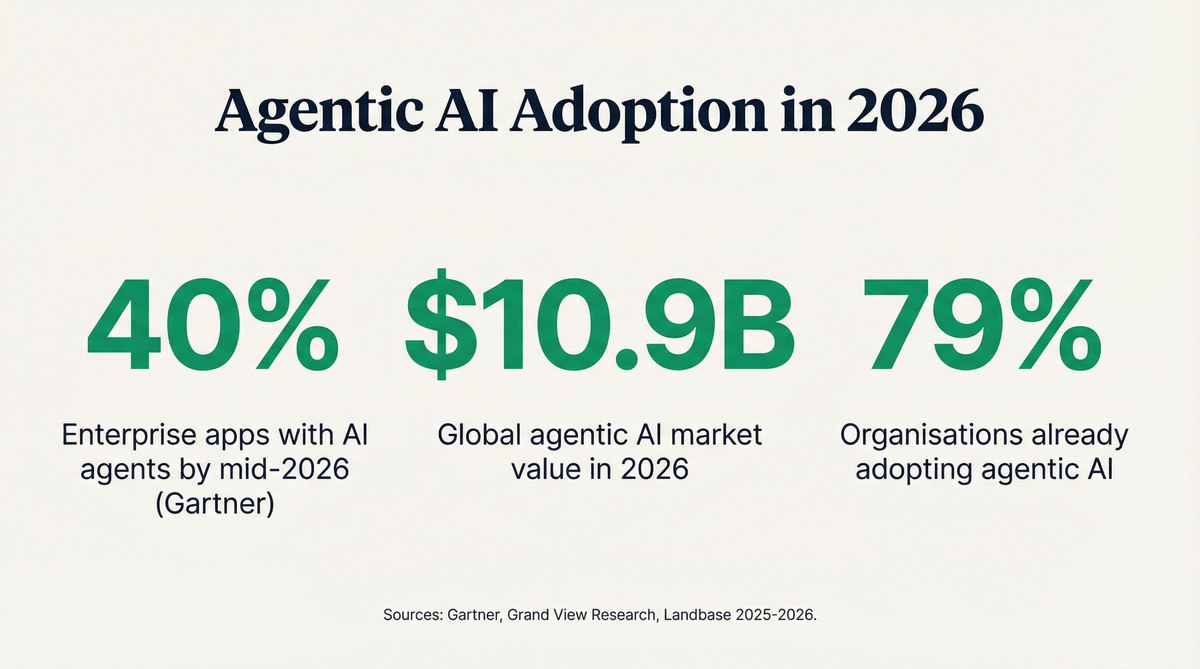
The timing has a lot to do with maturity. In 2024, fewer than 1% of enterprise applications had agentic capabilities. Analysts now expect that figure to hit 40% by mid-2026.
That’s not hype. That’s a structural shift driven by three things:
- Large language models are now reliable enough to reason through multi-step tasks
- Enterprise software has opened up APIs that agents can connect to and act on
- The ROI is measurable – not projected, but demonstrated
McKinsey estimates that AI agents could add $2.6 to $4.4 trillion in value annually across business use cases. The global agentic AI market reached around $7.6–7.8 billion in 2025 and is projected to exceed $10.9 billion in 2026.
The pilot phase is over: 2026 is the year agents move from experiments into production.
What Can Agentic AI in Business Actually Do?
This is where it gets concrete. Agentic AI in business isn’t one thing. It’s a category of autonomous AI systems applied across many functions.
Customer Support
Agentic systems handle Tier-2 and Tier-3 support tickets end-to-end. They research the issue, apply policy, execute actions like refunds or account updates, and document the outcome, all without a human touching the ticket.
Wells Fargo’s virtual assistant, Fargo, completed over 242 million fully autonomous customer interactions, handling requests that previously required trained human agents.
Gartner projects that autonomous systems could resolve up to 80% of customer support interactions by 2029.
Finance and Compliance
In finance, agentic AI monitors transactions in real time, flags anomalies, and executes reporting workflows automatically.
JPMorgan Chase uses agentic AI to automate legal and compliance processes, reporting up to 20% efficiency gains in compliance cycles.
Automated invoicing, forecasting, and expense auditing are accelerating financial close processes by 30–50%.
Supply Chain and Operations
An agentic supply chain system doesn’t wait for a human to notice a disruption. It detects the issue, reroutes deliveries, notifies suppliers, and updates inventory records, all in minutes.
Walmart deployed an agentic end-to-end workflow that anticipates demand and keeps orders moving before human staff even clock in.
Siemens and PepsiCo went a step further at CES 2026, using AI agents to simulate supply chain changes at physics-level accuracy before any physical modification is made.
Sales and Marketing
Sales agents research prospects, personalise outreach, book meetings, and update the CRM. Marketing agents monitor campaign performance, adjust spend, and flag underperforming creatives.
Businesses using agentic AI in sales report saving 40+ hours per month in manual research and admin alone.
IT and Security
Agentic security operations centres (SOCs) triage alerts, investigate threat patterns across the network, and execute containment actions, all without waiting for a human analyst to start their shift.
TELUS, with 57,000 employees, deployed agentic AI across operations via Google Cloud, saving 40 minutes per AI interaction across the workforce.
How Does Agentic AI in Business Work?
Most enterprise deployments use a multi-agent architecture. Each agent handles a narrow, specialised task. One agent detects the problem; another handles communication; a third updates records. They coordinate without human direction.
Multi-agent setups are more scalable and far more flexible than single-agent systems for solving complex, cross-departmental problems.
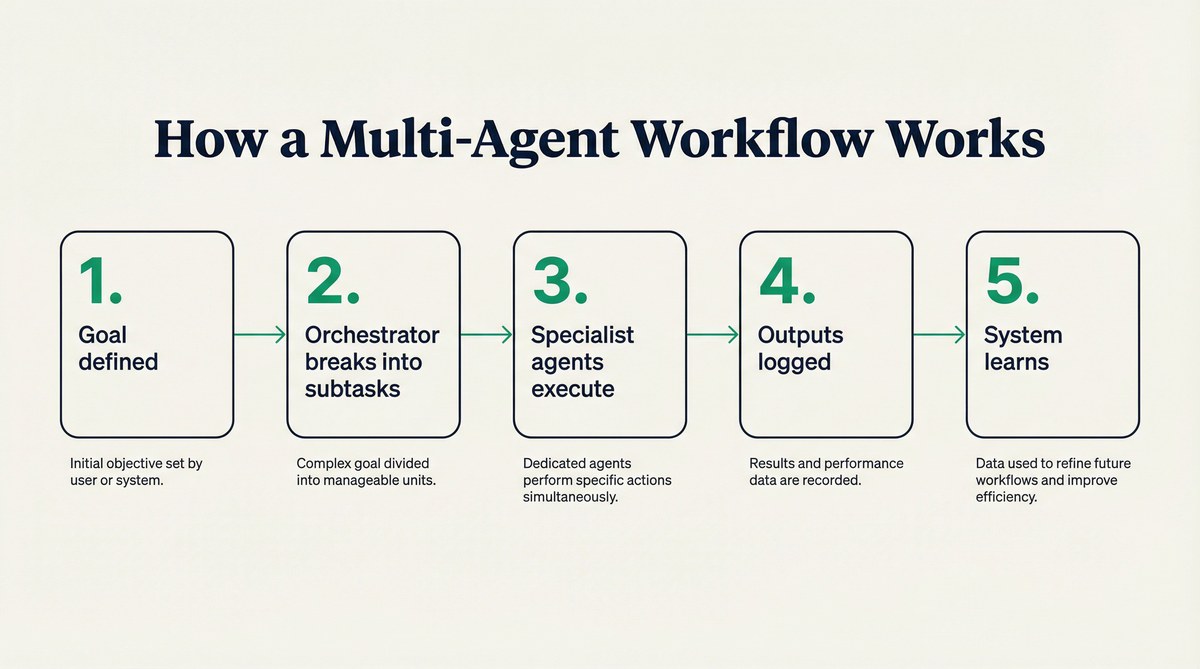
Here’s how a typical agentic workflow runs in practice:
- A goal is defined (e.g., “process all incoming supplier invoices”)
- The orchestrating agent breaks it into subtasks
- Specialist agents handle each subtask: reading documents, checking policy, flagging exceptions
- Outputs are logged and escalated only if needed
- The system learns from each completed cycle
What Industries Are Adopting Agentic AI Fastest?
Adoption is broad, but a few sectors are moving faster than others:
| Industry | Primary use cases |
|---|---|
| Financial services | Fraud detection, compliance, trading, onboarding |
| Healthcare | Diagnostics support, scheduling, documentation |
| Retail and e-commerce | Inventory, personalisation, merchandising |
| Manufacturing | Supply chain optimisation, predictive maintenance |
| Technology | Software development, security operations |
| Professional services | Research, document processing, client management |
As of 2025, 79% of organisations report some level of agentic AI adoption, with 96% planning to expand their usage.
What Should Businesses Think About Before Starting?
Agentic AI delivers real results, but it also introduces real responsibilities. A few things worth thinking through before deployment:
- Governance matters. Agents that act autonomously need clear rules about what they can and can’t do without human approval.
- Integration depth determines value. The more systems an agent can connect to, the more it can actually accomplish.
- Start narrow. The most successful deployments pick one high-volume, well-defined process and build from there.
- Human-in-the-loop controls are still standard. Most enterprises keep humans available for edge cases and high-stakes decisions.
Clear ROI, observability, and human oversight controls are what separate agentic AI projects that scale from ones that stall.
Conclusion
Agentic AI in business has moved well past the experiment stage. Companies across finance, retail, healthcare, and operations are running autonomous AI systems in production right now – and the results are measurable. The technology works best when it’s applied to high-volume, multi-step processes with clear goals and good data. If you’re thinking about where to start, pick one workflow, define the goal precisely, and build from there.
FAQ about agentic AI in business
What is the difference between agentic AI and traditional AI?
Traditional AI responds to prompts or follows fixed rules. Agentic AI sets its own plan, takes action across connected systems, and adapts when conditions change; all to reach a goal with minimal human direction.
Is agentic AI the same as automation?
Not quite. Traditional automation follows rigid scripts. Agentic AI makes contextual decisions, handles exceptions, and learns from each cycle, making it far more flexible than rule-based automation.
How much does agentic AI cost to implement?
Costs vary widely by complexity and vendor. Some platforms are accessible to mid-market businesses without heavy IT resources; others require significant integration work and infrastructure investment.
Is agentic AI safe to use in business?
It can be, when deployed with proper governance. Most enterprise deployments include human-in-the-loop controls, audit logs, and defined escalation paths to manage risk.
